
New analysis finds long-standing disparity in newborn survival between Flint and Michigan largely disappeared after launch of prenatal and infant cash support program
A new study has found that neonatal mortality—the death of an infant within the first 28 days of life—fell by nearly 50% in Flint following the launch of Rx Kids, the nation’s first community-wide maternal and infant cash prescription program. The decline represents a dramatic narrowing of a long-standing disparity between Flint and the rest of Michigan.
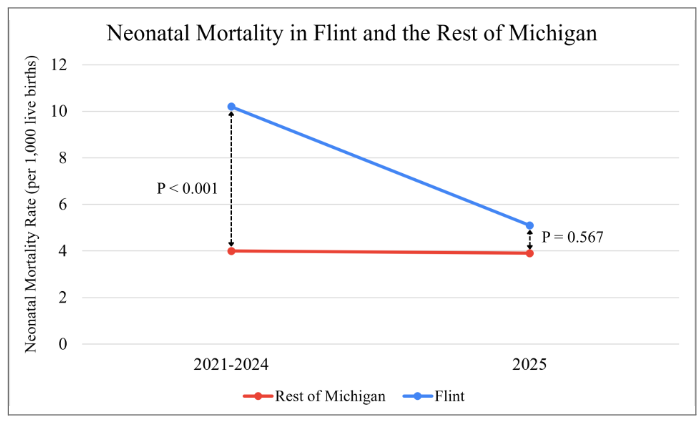
Neonatal mortality is one of the most important indicators of a community’s health and reflects conditions during pregnancy, delivery, and the earliest days of life. From 2021 to 2024, Flint recorded 10.2 neonatal deaths per 1,000 live births, compared with 4.0 in the rest of the state.
In 2025, one year after Rx Kids began providing direct support to expecting mothers and families, Flint’s rate dropped to 5.1 deaths per 1,000 live births. The statewide rate was 3.9 in 2025. The difference between Flint and the rest of Michigan was statistically significant prior to 2025 but was no longer statistically significant in 2025.
“For generations, Flint families have carried the burden of some of the highest infant mortality rates in our state,” said Flint Mayor Sheldon Neeley. “Seeing that gap narrow is a powerful reminder that when we invest in families, we can change outcomes. Behind these numbers are real babies, real parents, and real futures. Every child deserves a healthy start, and every family deserves the opportunity to watch their child grow and thrive. We are proud that Flint continues to lead with innovative solutions that support families and strengthen our community. The success of programs like Rx Kids demonstrates what is possible when we work together to remove barriers, provide support, and give every child the strongest possible start in life.”
For years, babies born in Flint were more than twice as likely to die during the neonatal period as babies elsewhere in Michigan. In 2025, that disparity was effectively eliminated, meaning that infants born in Flint were just as likely to survive their first month of life as babies born elsewhere in Michigan.
“As a pediatrician, I have stood beside families in the darkest moments of losing a baby, and the grief that follows is beyond measure,” said Dr. Mona Hanna, director of Rx Kids and associate dean of public health at Michigan State University College of Human Medicine. “These findings suggest that this pro-family, prevention-driven program may be helping more babies survive their earliest days, and it also reaffirms the importance of place-based investments to help narrow long-standing place-based disparities. Behind every statistic is a baby who celebrated their first month of life and a family spared an unimaginable loss.”
The study analyzed statewide birth and neonatal death records from 2021 to 2025. Researchers compared Flint with the rest of Michigan before and after the program’s launch. While Flint is a relatively small city and annual numbers are modest, researchers note that neonatal mortality is a rare but critically important outcome. A reduction of this magnitude represents one of the most meaningful improvements in infant health that a community can experience.
“When it comes to the health of newborns, this is the end-all-be-all outcome,” said Luke Shaefer, Rx Kids co-founder and Chief Executive of Health, Human Services, and Poverty Solutions for the City of Detroit. “Adoption of Rx Kids saw the erasure of the disparity in neonatal mortality between Flint and the rest of Michigan. It’s a dream come true.”
The findings build on peer-reviewed research published last month in The Lancet Public Health, which found significant improvements in birth outcomes among Flint babies following the launch of Rx Kids, including an estimated 18% reduction in preterm births, a 27% reduction in low birth weight, and a 29% reduction in neonatal intensive care unit admissions. Because preterm birth and low birth weight are among the leading causes of neonatal mortality, researchers say the decline in newborn deaths is consistent with these earlier findings.
“Being born too soon or too small can mean the difference between life and death in a baby’s first month,” said Dr. Sumit Agarwal, a physician and health economist at the University of Michigan, assistant professor at the U-M Medical School and School of Public Health, and a faculty affiliate of Poverty Solutions at U-M. “The reduction in neonatal mortality seen in Flint is exactly what we would expect after improving rates of healthy births. When we invest in families during pregnancy and infancy, more babies are born healthy and more babies make it through those critical first weeks of life.”
Researchers note that healthy babies begin with healthy pregnancies. Access to food, stable housing, transportation, prenatal care, and essential baby supplies can all influence maternal and infant health during this critical period. Previous Rx Kids research has shown improvements in housing stability, food hardship, maternal mental health, as well as an increase in prenatal care utilization and trust in healthcare institutions. Along with a decrease in smoking during pregnancy, all of these outcomes are key drivers of healthier babies. Additionally, Rx Kids families frequently report using funds to purchase baby supplies, including cribs and bassinets, which may support safer sleep environments for babies which prevents infant deaths.
Rx Kids was designed to improve maternal and infant health by addressing the economic shock that accompanies childbirth, when income often drops and expenses surge. At the same time, this period marks a critical window for child development, with conditions in utero and early infancy shaping lifelong health and development. The program provides $1,500 during pregnancy and $500 per month during infancy for babies in participating communities.
Since launching in Flint in 2024, Rx Kids has expanded to nearly 50 Michigan communities and provided direct support to more than 13,000 families. The program has demonstrated improvements in family financial stability, prevention of child welfare system involvement, and meaningful economic benefits, with millions of dollars flowing directly into local businesses and communities.
Rx Kids is led by Michigan State University and administered by GiveDirectly, with support from the State of Michigan and a growing family of funders, through a public–private partnership.


